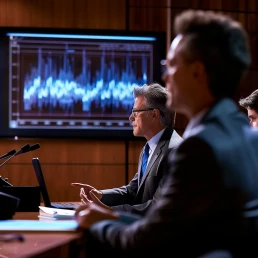
In The George Zimmerman/Trayvon Martin Trial, Who Cried For “Help” During the 911 Call?

The George Zimmerman/Trayvon Martin case is gearing up for trial, and with the state prosecutor’s introduction of audio voice ID experts, it is surely one of the more controversial forensic audio cases we’ve seen in the last few years. The defense is claiming these state experts are using unproven and non scientific techniques.

For those who aren’t aware of the case, George Zimmerman was on a neighborhood watch patrol and spotted 17-year-old Trayvon Martin walking through the neighborhood in the rain. Zimmerman claims Martin was acting suspiciously, and seeing as there had been a recent string of burglaries in the neighborhood, Zimmerman decided to follow him, at which point an altercation ensued, resulting in Zimmerman firing one fatal shot into Martin’s chest, which he claims was in self-defense.

While the incident was in progress, a neighbor called 911, and in the background of that call, we can clearly hear an individual screaming for “help.” We know that only two people were involved in the altercation: Trayvon Martin and George Zimmerman. So how can we figure out which one of them was calling for help? The prosecution is claiming that their voice ID experts can uncover the answer through their use of audio enhancement and audio analysis software.

Just like with fingerprints, every person on this earth has their own unique voice: no two voices are the same. With fingerprints, we distinguish between them through a close-up visual observation. With voice, you can also look at the audio signal closeup to distinguish differences.

Using high tech tools, a piece of audio can be uploaded into software and converted to a visual signal over a timeline. You can study that visual, digital representation of sound to observe how an individual pronounces words and even individual letters.

For example, every person says the word “couch” differently. So, assuming you can gather a clear sample of two people saying “couch,” when you forensically compare the two people’s pronunciation of the word, you’re able to see how each audio sample is different from one another.

But in order to do a comparison such as this, one has to have recordings of multiple words said by the people under review. Not only that, but it’s important to note that words that are said in duress would not give the same results as words said during relative calm.

In the Zimmerman/Martin case, not only are there very few words on the 911 call, but they are said in extreme duress. In addition, the sound of those few words is of very poor quality!

Although the prosecution’s expert claims the yelling is not from Zimmerman, I believe it is impossible for this to be supported in court. Maybe in the future, new technology and techniques will be available, but not today. And the defense audio experts — who are, by the way, much more respected in this field than the prosecution audio experts — agree with me.

It will be interesting to see the specifics of the voice experts testimony, how the judge rules on the experts being used in this case, and more importantly, how the experts are utilized during trial.

Posted in Enhancement of audio and video | Tagged , , , , , , , , , , , , , , | Leave a comment

Statue of Liberty to Use Facial Recognition Surveillance Technology Upon Re-Opening

Since the French first gave it to us in 1886, The Statue of Liberty has become the most recognized symbol of the United States of America.  For more than 120 years, countless eyes have gazed up at Lady Liberty and marveled at her beauty and her symbolic meaning of freedom and democracy.

So why would we ever think that Lady Liberty herself would be staring back down at us, scanning our faces and racially profiling us?  Well according to Ryan Gallagher at Slate.com, that’s exactly the case.

Liberty Island, which has been closed to the public since Hurricane Sandy slammed the east coast last summer, is set to reopen on July 4th.  Very fitting, right?  A symbol of America coming back to life on America’s birthday.  But when the island reopens, there will be some newly-installed, state-of-the-art security measures in effect:  Most notably, facial recognition technology.

Now, this type of surveillance technology is nothing new; there have been variations of it that have come out over the years, but those who are familiar with facial recognition software understand that the technology still has a ways to go before it can be utilized efficiently.  According to Gallagher, the Statue of Liberty actually first experimented with an early version of this surveillance software back in 2002, but as far as its’ effectiveness, the ACLU was quoted as saying, “Osama Bin Laden himself could easily dodge it.”

However, since 2002, the facial recognition technology has significantly advanced, and last year, Police Product Insight magazine reported that a trial of the latest software would be installed at the Statue of Liberty near the end of 2012.

Gallagher decided to look into this, and found that New York-based surveillance camera contractor Total Recall Corp. had been quoted as saying that this new software is called “FaceVACS,” made by Cognitec, a German firm.  Cognitec boasts that FaceVACS can “guess ethnicity based on a person’s skin color, flag suspects on watch lists, estimate the age of a person, detect gender, ‘track’ faces in real time, and help identify suspects if they have tried to evade detection by putting on glasses, growing a beard or changing their hairstyle.”

Gallagher was interested in learning more about this new facial recognition software, so this past March, he spoke with Statue of Liberty superintendent Dave Luchsinger, who confirmed that plans were indeed underway to install a new ‘state-of-the-art’ video surveillance system on the island in time for the July 4th reopening.  And when asked about facial recognition technology, Luchsinger directly acknowledged it and said, “We do work with Cognitec, but right now because of what happened with Sandy it put a lot of different pilots that we are doing on hold.”

Here’s where the story starts to get scary…

Gallagher then phoned Total Recall’s director of business development, Peter Millius, who said, “It’s still months away, and the facial recognition right now is not going to be part of this phase.”  Then, he put Gallagher on hold for a few minutes, and when he returned to the phone, he suddenly insisted that the facial recognition project had in fact been vetoed by the Park Police, and that Gallagher was in no way ‘authorized’ to write or publish anything about the project.

Gallagher immediately saw this sudden change in position as a suspicious red flag, and as he explains, the situation suddenly became even tenser:

“About an hour after I spoke with Total Recall, an email from Cognitec landed in my inbox.  It was from the company’s marketing manager, Elke Oberg, who had just one day earlier told me in a phone interview that ‘yes, they are going to try out our technology there’ in response to questions about a face-recognition pilot at the statue.  Now, Oberg had sent a letter ordering me to ‘refrain from publishing any information about the use of face recognition at the Statue of Liberty.’  It said that I had ‘false information,’ that the project had been ‘cancelled,’ and that if I wrote about it, there would be ‘legal action.’  Total Recall then separately sent me an almost identical letter – warning me not to write ‘any information about Total Recall and the Statue of Liberty or the use of face recognition at the Statue of Liberty.’”

So what can be taken away from this?

Clearly, facial recognition surveillance technology will indeed be used at Liberty Island upon its reopening, and it would seem that Gallagher was able to speak with people regarding this before they were given the order not to speak about it (or, maybe they just got the memo too late).  Once it became clear that a journalist had gotten wind of the project, these people were obviously told by higher-ups to do a 180 and deny everything that they had said before, and the very fact that they threatened Gallagher with legal action clearly shows that there is something to hide here.

Sure, a few years ago, one could look at this as just another “paranoid conspiracy theory.”  But with all the government scandals that have surfaced over the last few weeks and months, and most notably the startling information regarding top-secret, nationwide surveillance that’s been provided by NSA whistle-blower Edward Snowden, is it really that far fetched to assume this is another surveillance-related invasion of privacy that Big Brother doesn’t want the public to be aware of?

Gallagher summarizes the situation brilliantly when he says, “The great irony here, of course, is that this is a story about a statue that stands to represent freedom and democracy in the modern world.  Yet at the heart of it are corporations issuing crude threats in an attempt to stifle legitimate journalism – and by extension dictate what citizens can and cannot know about the potential use of contentious surveillance tools used to monitor them as they visit that very statue… [and] the attempt to silence reporting on the mere prospect of it is part of an alarming wider trend to curtail discussion about new security technologies that are (re)shaping society.”

Posted in Enhancement of audio and video, In The News - Surveillance | Tagged , , , , , , , , , , , , , , , , , , , , , , , , , , , | Leave a comment

At C.A.L.I Meeting, NCAVF Learned More About ALPR Surveillance

Two nights ago we were honored to speak in front of a group of private investigators at the San Fernando Valley C.A.L.I. (California Association of Licensed Investigators) district meeting.  Not only was our presentation well-received, but we learned a few things ourselves.

A portion of our talk focused on a fairly new law enforcement surveillance technology called ALPRs, or Automatic License Plate Readers.  One of the attendees at the meeting was a California Highway Patrol officer who gave us great insight into how ALPRs are utilized in the field.

ALPRs work by scanning thousands of license plates a minute.  And ALPRs are everywhere:  Intersections, highways, tolls, bridges, tunnels, on police cruisers and even on public works vehicles such as school buses, street sweepers and garbage trucks.  This surveillance data is then compiled into a massive digital database, and seeing as your license plate is recorded everywhere you go, law enforcement is able to put together a pretty clear picture of what you are up to on a daily basis.

The officer showed the group an application on his smartphone that gives law enforcement instant access to the ALPR surveillance database, allowing officers to search any license plate at any time (on or off the clock).  The resulting information is referred to as a “Hot List,” and tells law enforcement where you live, exact locations that you often frequent, license plate numbers of cars that are often in close proximity to yours, and where those people live and frequent as well:  An endless spiderweb of personal information right in the palm of their hand.  How ALPRs work and what they are capable of is no secret, the information is out there and we’ve seen it being marketed at trade shows, but it was truly remarkable to hear the officer speak about it first-hand.

Say the officer comes across a suspicious person with an out-of-state license plate?  Well, by plugging in the license plate, the officer will immediately be able to find the drivers home address, wherever that may be.  From there, it’s just as simple as following the ALPR data-trail to see when the driver arrived in-state.  Once the trail is established, the officer is able to put the pieces together and figure out what in-state license plate numbers are associated with the out-of-state driver, giving the officer a very good chance of now finding that driver.

However, the officer made it a point to say that if any officers are ever caught using the database for personal use, such as to track down a pretty girl they met at the bar for example, that termination is immediate.  The officer also said that the California Highway Patrol in particular is notorious for being very strict when it comes to investigating and disciplining those who abuse this power.

On one hand, this surveillance technology is absolutely fascinating.  But on the other hand, there’s no denying that it is truly frightening that it’s that easy to track and learn about everyday citizens, either criminal or law-abiding.  This is the world we live in now, though, and the ALPR technology will only continue to improve.  Therefore, it’s important that we as citizens stay up to date and are aware of the surveillance methods that are out there.  Because Big Brother is indeed watching…and listening…and taking notes.

Posted in Enhancement of audio and video | Tagged , , , , , , , , , , , , , | Leave a comment

Ohio to Use Portable Video Surveillance Towers

According to The Columbus Dispatch, the Investigative Unit of the Ohio Department of Public Safety has just purchased two state-of-the-art portable surveillance towers, equipped with an HD video and audio surveillance camera system.

Made by Flir Systems Inc. of Alpharetta, GA, the two towers cost taxpayers over $250,000 dollars — however half of that cost will be paid for by homeland-security funds.

Eric Wolf, head of Ohio’s Investigative Unit, said the towers will be used mainly for events that bring in large crowds, such as the Ohio State Fair and outdoor concerts.  “We’re going to be looking at what people are doing in large crowds, not spying to see what people are doing in their neighborhoods.  They [the trucks] will be used to enhance our ability to help control the overall safety at larger events and concerts.”

The towers can fit two people inside and can be raised up to 25 feet high.  They are also attached to towable trailers, and are equipped with spotlights, loudspeakers, five surveillance cameras and a radar system.  According to Flir, they offer a “completely customized surveillance platform suitable for high-level, temporary security ventures, providing a bird’s-eye view of the surrounding area.”

Wolf, whose unit focuses primarily on alcohol-related violations, hopes the towers be useful at events such as Jamboree in the Hills, a popular country-music festival that is often the site of countless underage-drinking arrests.

However, many are uncomfortable with the idea of a large tower being brought in specifically to watch people.  But Wolf reminds those people:  Just because these towers are large and visible doesn’t take away from the fact that we are all under surveillance almost everywhere we go these days.

Posted in Enhancement of audio and video | Tagged , , , , , , , , , , , | Leave a comment

License plate readers record massive data, LAPD sued for breech of privacy

Automatic License Plate Readers (ALPRs) are the next tool in police surveillance technology that will be challenged by individuals concerned with invasion of privacy.  On the surface, if used properly, ALPRs could help fight crime. However, the ability for this new technology to be accessed by individuals with less than honorable motives is very troubling.

Joshua Rhett Miller at Fox News is reporting that the American Civil Liberties Union (ACLU) is teaming up with the Electronic Frontier Foundation (EFF) in a joint lawsuit against the Los Angeles Police Department.

According to the lawsuit, the LAPD has been collecting massive amounts of data using ALPRs. These surveillance video cameras are located at traffic lights, street signs and in police squad cars, and can record as many as 1800 plates per minute, conducting approximately 22 scans for every one of the 7 million vehicles registered in Los Angeles County. By using these high definition cameras, the LAPD can track the movements of millions of motorists, and according to a June report in LA Weekly, the LAPD has already accumulated more than 160 million “data points.”

As EFF Staff Attorney Jennifer Lynch explains, a data point can be considered anywhere you often go in everyday life. “By matching your car to a particular time, date and location – and building a database of that information over time – law enforcement can learn where you work and live, what doctor you go to, which religious services you attend, and who your friends are.” Lynch feels that the public should have access to this data, seeing as the daily routines of countless law-abiding citizens is being recorded, monitored and documented.

The lawsuit goes on to say that the ALPR system also uses “hot lists,” comprised of “user defined data that is manually input into the informational data file so that ALPR users will be alerted whenever a ‘vehicle of interest’ is located.” The ACLU claims that this past October, they sent a second request to the Los Angeles Sheriff’s Department asking for more information regarding these “hot lists,” and that authorities declined to provide any details.

ACLU-SC Senior Staff Attorney Peter Bibring says he feels that police should treat location information from ALPRs like any other sensitive information. “They should retain it no longer than necessary to determine if it might be relevant to a crime and get a warrant if they need to keep it any longer. They should limit who can access it, who they can share it with and create an oversight system to make sure the limits are followed.”

However, Los Angeles County Sheriff spokesman Lee Baca said, “The irony is we share the concern of privacy. Do we want to release files on people who have done nothing wrong?”

Be sure to check back with the NCAVF for updates on this on-going case and developments with analyzing, enhancing, and testifying as an expert witness on video and audio surveillance and other related emerging surveillance technologies.

Posted in Enhancement of audio and video | Tagged , , , , , , , , , , , , , , , , | Leave a comment

Recent NCAVF Media Appearances Regarding the Boston Bombings

In the wake of the horrific terrorist bombings in Boston last month, NCAVF Video Forensic Expert David Notowitz served as a consultant to radio and television stations across the country to give insight into what forensic investigators were doing to solve the case.  In the end, as David discusses in the following interviews below, it was audio and video retrieval, analysis, and enhancements to surveillance video, handheld smartphone video recordings, and still photos that ultimately led to the capture of the Tsarnaev brothers.

KCBS Radio in San Francisco:  Click Here to Listen and Click Here for the Transcript.

WGN Radio in Chicago:  Click Here to Listen and Click Here for the Transcript.

- CBS2 News in Los Angeles:  Click Here to Watch and Click Here for the Transcript.

- CW6 News in San Diego:  Click Here to Watch and Click Here for the Transcript.

- KABC7 News in Los Angeles:  Click Here to Watch and Click Here for the Transcript.


Posted in Enhancement of audio and video | Tagged , , , , , , , , , , , , , , , , , , , , | Leave a comment

San Diego 6 News Interview with NCAVF Video Expert About the Boston Bombings

NCAVF was featured in a news report by San Diego 6 News, about what forensic investigators are doing to solve the Boston Bombings.

Click here to watch, and the transcript is below.


BEGIN TRANSCRIPT

BEGIN ANCHOR LEAD-IN:

MALE ANCHOR:  And as investigators sort through numerous leads in Boston, they are also asking for more in the form of photo…photos and video recordings.  Nancy Aziz joins us in-studio with how videotape evidence may play a role in capturing the suspect.  Nancy?

NANCY AZIZ:  Well every bit of video of the scene may prove to hold crucial information.  Experts tell us that things that don’t seem important right now, may end up being key to the investigation.  So the FBI is asking the public to hand over any video or pictures of the scene, and experts will pour over every bit of it, looking for clues.

BEGIN PACKAGE:

NA (VOICE-OVER):  Boston authorities will be sifting through a mountain of evidence, as they search for who’s responsible.  Still-pictures, cell phone video, surveillance tapes.

DAVID NOTOWITZ:  It’s a huge task, enormous task, a lot of man-hours…

NA (VO):  David Notowitz, founder of the National Center for Audio & Visual Forensics in Los Angeles, offered his insights into how the process may work.  He says investigators will likely start at the blast site, and work out from there.

DN (VO):  So, for example, you see someone arrive to this location that’s suspicious, well, lets track them backwards in time.  Which street did they come down?  Which surveillance caught them coming down the street?  Maybe they came through a subway, maybe they came through..they went through a hardware store.

NA (VO):  Video of the day of the event will prove important, as may video captured days, even weeks, before.

DN:  You want to look for people that are meandering, in a strange way, taking pictures, taking measurements.

NA (VO):  Notowitz says audio of the blast themselves, may also provide clues.

DN (VO):  They’ll know, maybe by the sound of it, if they get close enough to that bomb, what that device was.

NA (VO):  Notowitz says there are tools investigators can use to enhance both audio and video.

DN (VO):  So we’ll zoom in on the screen, we’ll…you know, affect contrast, we will play with the brightness, we will, with audio, take audio and filter out background noise.

NA (VO):  Even evidence that seems insignificant by itself may prove valuable, Notowitz says, when layered in a timeline, so that audio from one source, offers clues to video from another.

DN (VO):  It builds on itself in a very interesting way, so that if you get multi-layers, and multi-screens going on at the same time with all this evidence, each piece will sometimes inform the other.

END PACKAGE.

NA:  And we are told it’s crucial law enforcement get a hold of any video surveillance tapes within the next week, that’s important because many surveillance systems automatically destroy recordings every few days.  Experts also say it’s important the video is saved in the highest quality form possible, so it’s as clear as can be.  Live in-studio, Nancy Aziz, San Diego 6 news.

END TRANSCRIPT.

Posted in Enhancement of audio and video | Tagged , , , , , , , , | Leave a comment

KABC7 Interviews NCAVF Forensic Video Expert About Boston Bombing

Here is a piece from ABC7 featuring NCAVF discussing video and audio forensic analysis and enhancement in relation to the Boston Bombings.

Click here to watch, and the transcript is below.


BEGIN TRANSCRIPT:

BEGIN ANCHOR LEAD-IN:

FEMALE ANCHOR:  …Federal investigators are working around the clock to find answers to these deadly bombings.  They are sorting through photos, videos and evidence at the scene.  Eyewitness News reporter CARLOS GRANDA joins us live now in the studio with what investigators have learned so far.  Carlos?

CARLOS GRANDA:  Well investigators found pieces of black nylon from a bag or a backpack, and fragments of nails and BB’s, all believed to be parts of the bombs, and they were possibly put together in ordinary kitchen pressure-cookers.

BEGIN PACKAGE:

CG (VOICEOVER):  A horrific site when the bombs went off.  Investigators are now analyzing the evidence those explosives left behind, debris that could yield valuable clues.

DAVID NOTOWITZ:  The focus is the bomb, that’s what the focus is, it has to be, and there…they looked at the materials on that bomb, they looked at who made…how it got possibly made, and they’re gonna track every piece of that bomb as much as they can.

CG (VO):  David Notowitz is from the National Center for Audio and Video Forensics.  He analyzes video evidence for use in court.  He says the FBI is now putting together hundreds of hours of video recordings from surveillance and traffic cameras, and peoples home videos.  Agents will need to examine everyone in the area.

DN:  But once they gather all this stuff, which is a lot of material, there’s no way for it to be automated, in terms of the search.  The search has to be done by a human being still.  There’s no surveillance software that can automatically pick out a face.

RICHARD DESLAURIERS:  All video like this, we encourage the public, and particularly business owners in that area, to continue to submit this information.  This is very, very important.

CG (VO):  We’re learning the bombs were possibly built out of kitchen pressure cookers, packed with nails, ball bearings and explosives.  Sources say it appears they were hidden in black duffle bags left on the ground.  BRIAN JENKINS is a terrorist expert with the RAND Corporation.

BRIAN JENKINS:  Pressure cooker is a bigger version of a pipe bomb.  You can clamp down a lid on a pressure cooker, you fill it with explosives, fill it with some kind of metal-debris, the pressure cooker itself can turn into debris, and, it builds up enormous force, and then bursts, creating shrapnel.

CG (VO):  And there are plenty of websites that show how to build these bombs.  Al Qaeda’s “Inspire Magazine,” published instructions for such a pressure cooker device back in 2010.

BJ:  Anyone can look at this information and, if halfway competent, can build some kind of an explosive device.

END PACKAGE.

CG:  And pressure cooker explosives have been used in Afghanistan and Pakistan.  All the evidence is now being analyzed at the FBI’s labs in Quantico, Virginia.  I’m Carlos Granda, ABC 7, Eyewitness News, Mark, back to you.

END TRANSCRIPT.

Posted in Enhancement of audio and video | Tagged , , , , , , , , , | Leave a comment

Loud calls for increased purchase of surveillance systems after successful Boston bombing investigation

The tragic and deadly terrorist bombings in Boston have lawmakers in cities across the country calling for more spending on surveillance equipment.  And rightfully so, seeing as it was surveillance footage that led to the capture of the culprits.

As Keith Proctor points out in his latest CNN Money article, the surveillance business, which has already been a booming industry over the last few years, will only continue to grow.  Most often, though, the main concern with widespread surveillance is whether or not our privacy rights as citizens are being infringed upon.  But events like the Boston Bombing force people to rethink their stance on the issue.

“The argument for greater surveillance is straightforward,” Proctor says.  “Horrible events in places like Boston remind us that we’re vulnerable.  The best way to limit events like last week’s bombings, the argument goes, is to accept 24-hour surveillance in public spaces.  And when  you see someone maimed by bomb shrapnel, privacy concerns sound coldly abstract.”

According to Proctor, since 9/11, federal spending on Homeland Security exceeds $790 billion:  that’s larger than both TARP and the New Deal!  But critics say due to lack of oversight, that money doesn’t always get used wisely.  Proctor reports that, “an Indiana county used its $300,000 Electronic Emergency Message Boards — to be used solely to alert the community of, you know, emergencies — to advertise the volunteer fire department’s fish fry. Western Michigan counties used homeland security dollars to purchase 13 $900 Sno-Cone machines.”

In the private sector, however, surveillance camera sales have exploded.  Last year in Florida, for example, surveillance footage was used in nearly 800 criminal investigations, leading to more than 100 arrests.

But compared to other parts of the world, the U.S. still has some catching up to do.  “…New York City has more than 4,000 cameras in Manhattan alone, according to the American Civil Liberties Union. Chicago’s linked public and private security cameras number around 10,000. But…in London — the Xanadu of winking, digital eyes — surveillance cameras total an estimated half-million.”

At the same time though, Homeland Security grants for states have actually dropped from $2 billion in 2003 to $294 million in 2012.  And with the “sequester,” those funds are expected to continue to dwindle.

So how do we stay safe?  The answer is quality over quantity: Improved technology.

Companies like Lockheed Martin and Northrop Grumman are shifting the industry towards what is considered the future of surveillance, referred to as “video analytics,” where “computers will automatically analyze camera feeds to count people, register temperature changes, and, via statistical algorithms, identify suspicious behavior. No technicians required.”  By 2020, the video analytic market is expected to be a $39 billion industry.

But until computers are smart enough to warn us before an incident is about to take place, we will continue to rely on surveillance experts to help us put the pieces together.

As the controversial discussion about increasing video and audio surveillance continues, be sure to check back with the NCAVF for the latest.

Posted in Enhancement of audio and video | Tagged , , , , , , , , , | Leave a comment

Privacy Watchdog Group Suing FBI Over Secret Surveillance Program

RT.com is reporting that the Electronic Privacy Information Center (EPIC), a privacy watchdog group, is suing the FBI over the agency’s failure to fulfill Freedom of Information Act requests.

For more than a year and a half, EPIC has been waiting for the FBI to deliver the legally-requested documents pertaining to the “Next Generation Identification,” or NGI, program, which is a regarded as a secretive government program that apparently has the capability to track down anyone, anywhere, at any time.

EPIC claims that the database pulls personal information from both public and private surveillance databases, and also incorporates the controversial Trapwire system, which can literally pinpoint someones exact location by simultaneously scanning individuals’ faces on any networked video and audio security surveillance system across the country, in real-time.

So what kind of information can be found in a persons’ NGI file?  Well, aside from all of your basic public, criminal and health records, the database will also compile DNA / facial recognition image profiles, palm prints, iris scans, behavior patterns such as style of walk, and some even speculate audio voice-analysis.

The FBI first publicly disclosed their NGI program nearly a decade ago, but have been tight-lipped about it ever since.  When asked about the program in 2012, the agency said it will be “bigger, faster and better” than the now-standard Integrated Automated Fingerprint Identification System (IAFIS), and said, at the time, that the database was more than 60% complete.  Once the program is at 100%, it’s speculated that it could take only a matter of 10 minutes to narrow in on a suspect.

Some might see NGI as an amazing technological breakthrough and enhancement of law enforcement capabilities, but EPIC feels the program is dangerous because it allows our government to compile video, audio, and biometric data on people who “are neither criminals nor suspects,” which they claim is an invasion of privacy.

EPIC hoped that by using the Freedom of Information Act, they would gain more clarity about the details and purpose of the NGI program.  But due to the FBI’s silence, EPIC has decided to move forward with their lawsuit.

Check back with NCAVF to keep up on all news related to forensic video and audio.

Posted in Enhancement of audio and video | Tagged , , , , , , , , , , | Leave a comment